Funeral Consultant at Memoria Funerals
Funeral Operations Manager at Memoria Funerals
A green funeral, sometimes called an eco funeral or a natural funeral, is a funeral arranged to reduce its environmental impact.
For some people, the environmental impact of a funeral is an important consideration, whether that is for themselves or for someone they love.
Green funerals may include woodland and natural burial, as well as more eco-friendly approaches to cremation, and there are choices you can make within almost any type of funeral to make it more sustainable.
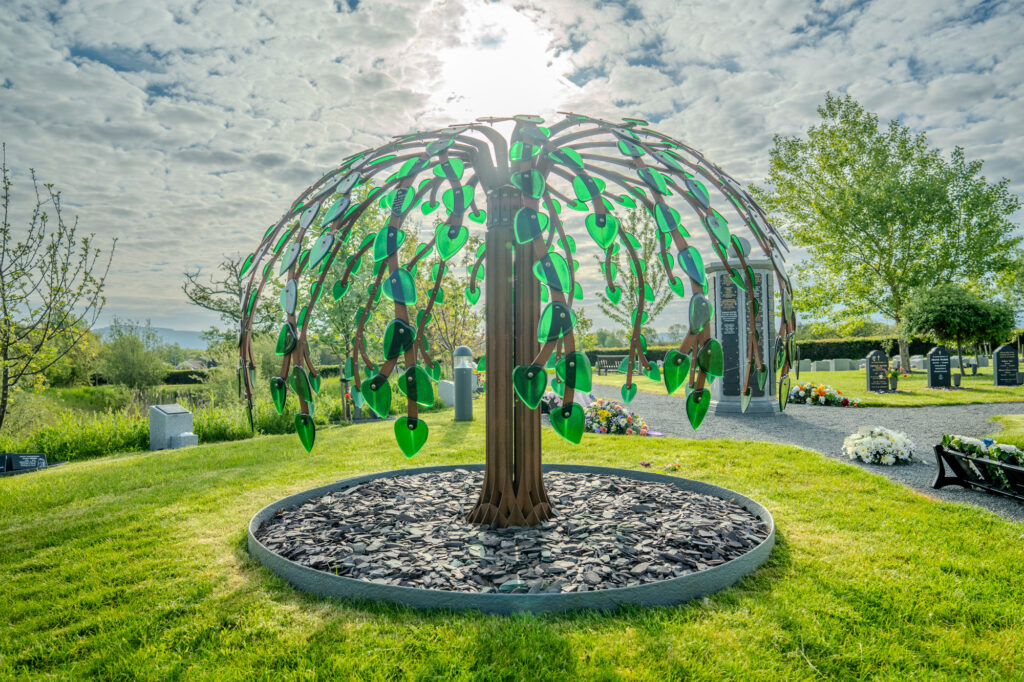
There is no single definition of a green funeral, and no official standard one has to meet. Generally, though, these are the things considered greener or more eco-friendly.
For most families it comes down to wanting the funeral to reflect how the person lived. Someone who spent their life outdoors, gardened, walked or cared about conservation may have wanted a farewell that fits with that.
There are practical reasons too. A green funeral is usually simpler, which some families find less overwhelming to arrange and less formal to attend.
A woodland burial ground can be a gentler place to visit than a cemetery. And for people who have thought about their environmental impact throughout their lives, it can feel important that the last decision made on their behalf is consistent with the rest.

To learn more about the options available, read our guide about the different funeral types.
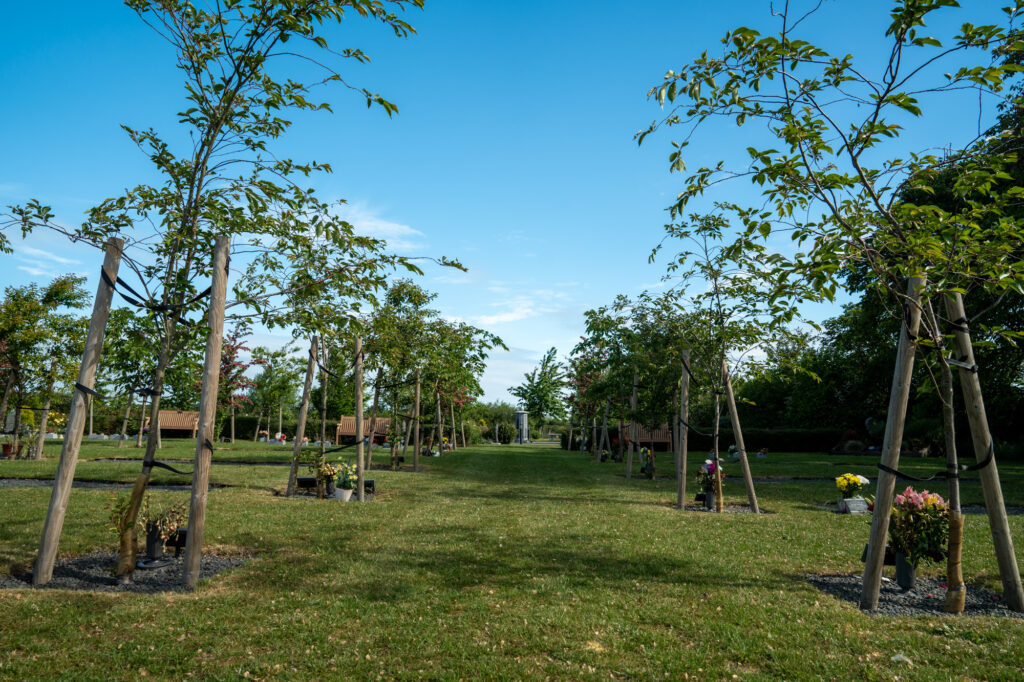
Natural burial, also called woodland burial or green burial, is what most people picture when they think of a green funeral. The burial takes place in a dedicated natural burial ground, which might be woodland, a meadow, an orchard or a coastal site. The land is managed as a nature reserve rather than a cemetery.
According to The Natural Death Centre, there are now more than 270 natural burial sites in the UK.
The service is usually held outdoors at the graveside, though many sites have a simple indoor space for bad weather. Families often carry the coffin themselves, and there is no set format, so the service can be religious, non-religious or entirely personal.
The coffin or shroud must be biodegradable, and embalming is not permitted at most sites. After the burial, the grave is left to settle and grass or wildflowers grow over it. Instead of a headstone, families usually plant a tree or mark the spot with a small wooden plaque or a flat stone.
Most sites keep a record of grave locations so families can find them again.
The Natural Death Centre charity keeps a directory of natural burial sites across the UK, and also runs the Association of Natural Burial Grounds, which sets a code of conduct for member sites.
Sites vary a lot in what they allow, so it is worth visiting before you decide. Ask what can be planted, whether you can visit the grave freely, and what happens to the land in the long term.
Some Memoria Funerals crematoria also offer natural burial, giving families the option of a more natural setting for the person’s final resting place.
Find out more about the burial options available at:
Generally yes, though it depends what you are comparing it to. Cremation uses energy and creates emissions, so it isn’t impact-free. But it doesn’t take up land permanently, while a traditional burial can involve embalming chemicals, a hardwood coffin, a concrete grave liner and a quarried stone memorial.
Of the two cremation options, direct and attended, direct cremation has the lower impact. It takes place without a funeral service or mourners present, so there are fewer journeys and no cortege, limousines, flowers, order-of-service booklets or venue to heat and light. Many families then hold their own gathering later, at a time and place that suits them.
Most UK crematoria still use gas cremators. Electric cremators are a newer, lower-emission alternative, and a small number of crematoria have started installing them.
Mercury abatement equipment, which filters mercury released by dental fillings, is now widely used across UK crematoria. Modern filtration systems also remove a range of other emissions before they leave the building.
At Memoria Funerals, we operate our own crematoria across England, Scotland, and Wales, and we were the first UK funeral provider to install an electric cremator.
We’re proud to say that 27% of our crematoriums now operate electric cremators, more than any other multi-site crematoria operator.
Memoria North Oxfordshire and Memoria Faversham and Mid Kent have both been awarded the Greener Globe Trusted Crematorium Platinum Award, the highest level of accreditation for environmental sustainability.
To achieve this award, our crematoria passed a rigorous, independent sustainability audit conducted by qualified assessors. This means every time you choose one of these Platinum crematoria you are actively reducing your own carbon footprint.
For more information, visit our page about how we’re reducing our environmental impact.
For more help, call Memoria Funerals free, with no pressure or obligation to buy, and our dedicated team will guide you through the process.
Water cremation, also known as resomation or alkaline hydrolysis, uses heated water and an alkaline solution instead of flame. It uses less energy, produces no direct emissions to air, and returns the remains to the family in much the same way as ashes.
It became legal in Scotland in March 2026, making it the first part of the UK to permit the process, though availability there remains limited and no providers are currently operating at scale.
The position in England and Wales is less clear cut. Water cremation isn’t specifically prohibited, but no legal framework covers it, so it isn’t currently offered.
For someone who lived on or beside the water, burial at sea can feel like a fitting choice. It is rare and tightly regulated, but some of its requirements also help reduce its environmental impact: the person must not be embalmed, and the coffin must be plain softwood, drilled with holes and weighted.
Scattering ashes at sea is simpler and doesn’t require a licence. Biodegradable, water-soluble urns are designed to float briefly before dissolving.
Memorial reefs are another option, where ashes are set into a stone structure placed on the seabed to provide habitat for marine life. There is currently only one memorial reef in UK waters, off the Dorset coast near Weymouth, so it is worth checking availability before planning around it.
The coffin is one of the simplest ways to reduce the environmental impact of a funeral, whether you choose burial or cremation.
Willow, wicker, bamboo, seagrass and banana leaf are lighter, woven options, while cardboard is usually the simplest and most affordable. Cardboard coffins can also be decorated or written on. Wool felt coffins are soft-sided, and some are made from British wool, while FSC-certified solid wood offers a more traditional look.
Most of these options can be used for burial or cremation, but natural burial grounds have their own rules, so check what they accept first.
It’s also worth knowing that a woven coffin isn’t automatically the greener choice for a cremation. Wicker and reed burn away very quickly, so they contribute little heat to the process and the cremator has to work harder, while solid wood helps generate that heat.
To learn more, see our guide on how much a funeral costs.
If you are considering burial, it’s worth knowing that there are fewer natural burial grounds than cemeteries, so the nearest one may be a long drive, both for the funeral and for visiting afterwards. Sites set rules about what you can plant and leave at a grave, and a grave with no headstone can be harder to find years later. Natural burial can also cost more than cremation, and newer options such as water cremation are still very limited.
Direct cremation is worth thinking about separately. Because there is no service and no mourners present, there is no goodbye at the moment the cremation takes place, which matters a great deal to some families. However, it does take away the pressure of arranging everything within a few days, and leaves you free to hold your own gathering later, somewhere that means something, whenever you feel ready.
None of these are reasons not to choose a green funeral. They are simply worth knowing in advance rather than discovering later.
You don’t have to choose a natural burial to bring the environmental impact of a funeral down. Small changes work within any type of service.
If you are planning ahead, our prepaid funeral plans can show you your options. If someone has already died and you need to arrange a funeral now, visit our arrange a funeral page.
See more in our guide on how to choose the right funeral plan.

Natural burial is generally considered the lowest-impact option currently available in the UK, because it avoids embalming chemicals, uses biodegradable materials and returns the ground to nature. That said, the footprint of any funeral depends heavily on travel, the coffin and how elaborate the service is.
Yes, and cremation is generally more eco-friendly than a traditional burial to begin with, because it doesn’t take up land permanently or involve a concrete grave liner and a stone memorial. You can choose a biodegradable coffin, keep travel and the number of cars to a minimum, and choose a biodegradable urn. Some UK crematoria now run electric cremators, which produce lower emissions than gas. A direct cremation removes the cortege and the ceremony, which brings the footprint down further.
Not automatically. What influences price the most is the type of funeral rather than how green it is. A cardboard or wicker coffin costs less than hardwood, and skipping embalming, limousines and printed booklets can all reduce the cost. But a woodland burial plot can run to several thousand pounds. A green cremation will usually be cheaper than a traditional funeral, while a green burial may not be.
Prices vary by material and supplier. Cardboard coffins are usually the least expensive, with willow, wicker, bamboo and seagrass costing more, and certified solid wood more again. Ask your funeral provider what they include as standard, because a biodegradable coffin is often no more expensive than the standard option.
There is no fixed timescale. Natural burial graves are usually dug shallower than traditional graves, in soil with more oxygen and microbial activity, which generally speeds up natural decomposition compared with a deep grave in a concrete-lined plot. Soil type, drainage, depth and the materials used all affect the time it takes.
*Industry statistics sourced from the SunLife Cost of Dying Report 2026 (www.sunlife.co.uk/funeral-costs).
Last updated: August 2026
